
Experiencing Urban Repair: Excursion to the Falckenberg Ensemble with WÖHR + BAUER
How can future-oriented urban development succeed within existing structures? This question was at the heart of an excursion by real estate management students of Prof. Dr. Gunnar Gombert and architecture students of Prof. Dr.-Ing. Bettina-Maria Müller from IU International University to the Munich-based development firm WÖHR + BAUER.
The focus of the visit was the formerly named "Tom & Hilde" development project – the Hofbräuhaus underground garage (Tom) and the subsequent new-build quarter Falckenberg Ensemble (Hilde). Two structurally and functionally linked components that exemplify how urban transformation, mixed use, mobility concepts, and sustainability can be integrated today.

From Parking Garage to Urban Quality
The starting point is typical for many city centers: an outdated elevated parking structure in a prime location, a lack of public space integration, and increasing pressure to rethink urban environments.
WÖHR + BAUER responded with a dual strategy:
Mobility infrastructure was created in the form of a modern underground garage beneath Thomas-Wimmer-Ring, offering not only parking spaces but also EV charging stations, sharing services, and parcel stations.
Urban repair was achieved through the Falckenberg Ensemble – two new urban buildings with residential, office, and gastronomy uses, along with the reactivation of the historic Falckenbergstraße as a pedestrian public passage.
The result: a project that convincingly combines mobility transition, urban quality of life, and economic viability.

Location and Urban Context
The project is located in Munich’s Graggenau district, part of the historic old town with immediate proximity to Marienplatz, the Hofbräuhaus, and the Viktualienmarkt. The dense historic fabric, significant neighboring buildings, and its location within the inner city ring make the site highly complex – both in terms of urban design and approvals.
A central element is the restoration of Falckenbergstraße as a public pedestrian corridor – a historic path long obstructed by previous structures, now reimagined as a connective urban axis between Maximilianstraße, Thomas-Wimmer-Ring, and the inner city.
A direct neighbor is the Mandarin Oriental Hotel, one of Munich’s most exclusive accommodations. As part of the development, the brand will integrate its “Residences at Mandarin Oriental” into the Falckenberg Ensemble – underscoring the international appeal and prime value of the location.

Project Timeline: A Chronology of Challenges
The path to realization was far from linear. Multiple redesigns were necessary to meet the evolving expectations of the city, public stakeholders, and investors.
2003: City council resolution to move surface parking underground
2013: WÖHR + BAUER wins the urban design competition for the Hildegardstraße site
2017–2021: Construction of the Hofbräuhaus underground garage as a foundation for further development
2021: Demolition of the old Fina parking structure and start of construction for the Falckenberg Ensemble
2021–2024: Multiple re-plannings regarding access, usage mix, and ESG criteria
2024: Groundbreaking for the new buildings
2027: Planned completion and occupancy of the above-ground structures
Project development had to respond flexibly to changes in urban planning assessments, approval conditions, and market dynamics. This iterative process offered valuable real-world insights, particularly for our students.

Learning at the Intersection of Theory and Practice
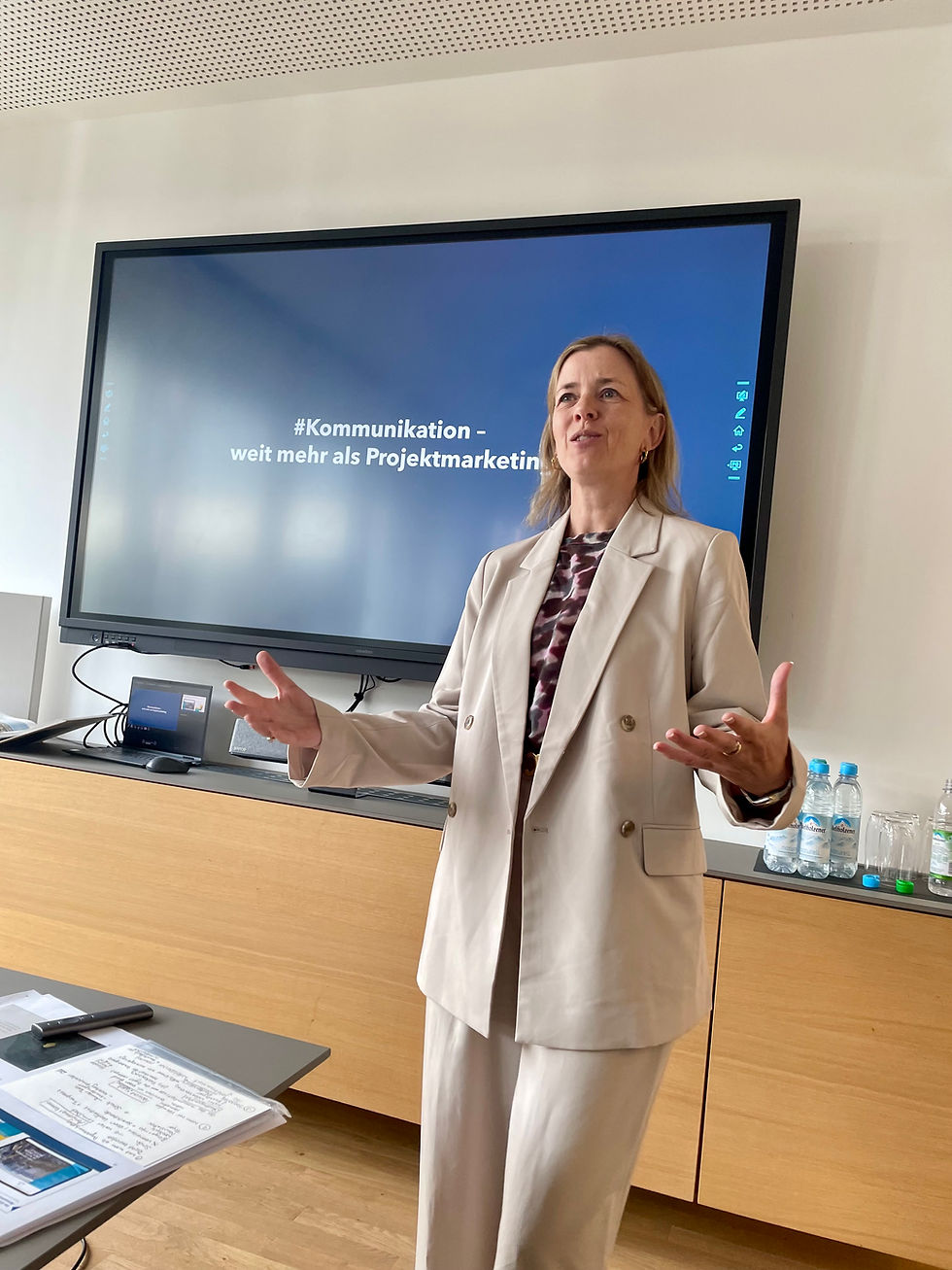
For our students, the visit was far more than a construction site tour. In dialogue with Oliver Vogt, Sonja Straubinger, and Andreas Schönberger, it became clear how complex the realization of such a project is: land acquisition, contamination issues, urban design obligations, ESG compliance, investor demands – all must be synthesized into a coherent development strategy.
Especially valuable were the honest discussions about construction challenges, permitting processes, cost developments, and the strategic principles guiding WÖHR + BAUER.
Students were able not only to apply their theoretical knowledge but also to gain a concrete understanding of how real estate development actually works – interdisciplinary, iterative, and entrepreneurial.

Strategic Perspective: Urban Repair as a Future Model
From a real estate strategy standpoint, the value of such projects is clear. The qualitative densification of existing neighborhoods and reactivation of inner-city sites are central levers for achieving ESG goals, enabling mobility transitions, and implementing sustainable urban use models.
This development is exemplary of a new generation of real estate projects:
Value creation through transformation, not expansion
Mobility infrastructure as part of the urban system
Real estate development as a contributor to urban quality
The excursion provided an excellent case study of how theory, practice, and strategic thinking intersect.

Cities Are Built Through Dialogue
Urban development thrives on exchange – and on ensuring that the next generation of professionals understands early on how to translate complex conditions into viable solutions.
Our sincere thanks go to the WÖHR + BAUER team for their openness, insight, and commitment to not only delivering urban development – but also sharing its lessons.


